The most common bathroom layout mistakes in UK homes are poor clearance space around sanitaryware, cramming too much into a small space, bad toilet placement, ignoring storage, and forgetting about lighting and ventilation. These errors make bathrooms uncomfortable to use on a daily basis and expensive to repair later. Getting the layout right from the start saves money, stress and costly refit work.
Get Free Bathroom Layout Quote | Call +44 7852 961732
Quick Checklist: Have You Made Any of These Errors?
- Less than 700mm of clear space in front of your toilet, basin or bath
- Toilet visible directly from the door or hallway
- No dedicated storage planned into the layout
- A bath crammed into a room too small for it
- Towel rail placed where it blocks movement
- Wet and dry zones mixed without proper separation
- Lighting planned as an afterthought
- Ventilation was ignored during the design phase
- Pipework was moved without checking the extra cost
- Layout copied from a showroom or Pinterest without measuring your actual room
If you ticked three or more of these, read every section below carefully. Each one shows you exactly what to fix and how to do it.
Ready to plan your bathroom the right way? 👉 Get our bathroom renovation and planning guidance and get it right the first time.
Why Getting Your Bathroom Layout Right Matters More Than Style
Most homeowners spend the bulk of their budget on tiles, taps and finishes. Layout planning often comes last or gets rushed. This is the root cause of almost every bathroom renovation regret.
A bathroom that looks stunning in photos but leaves you knocking your elbows on the basin, squeezing past the door to reach the toilet, or searching for somewhere to put a towel is not a successful bathroom. Function has to come first.
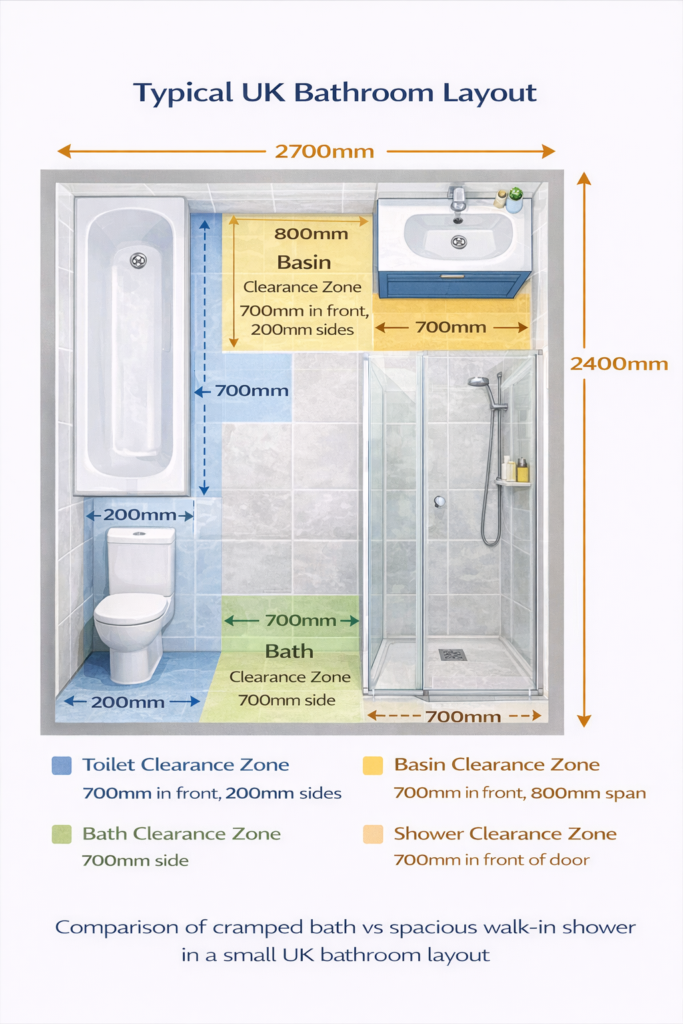
According to Victorian Plumbing’s research, the average UK bathroom measures around 2,700mm x 2,400mm, which is roughly the size of two king-sized mattresses. That is not a lot of space to fit a toilet, basin, bath or shower, storage and heating. Every millimetre counts.
UK Building Regulations, specifically Part M and Part G, also set standards for how much clearance space your sanitaryware must have. Ignoring these during planning does not just make your bathroom awkward to use. It can also cause problems when you come to sell your home.
11 Bathroom Layout Mistakes
Mistake 1: Getting the Clearance Space Wrong Around Sanitaryware
This is the single most common and most damaging bathroom planning error made in UK homes. Poor clearance is not just uncomfortable. It makes your bathroom feel smaller, harder to clean and genuinely unpleasant to use every morning.
UK building standards recommend a clear floor space of at least 700mm from the front edge of all fixtures, including your basin, toilet, bath and shower, to any wall, opposite fixture or obstacle. For your basin, you also need at least 800mm of side-to-side space to give your elbows room when brushing your teeth. For your toilet, allow a minimum of 200mm between the side of the pan and any wall or nearby fitting.
What to do instead: Before you buy a single piece of sanitaryware, draw your room to scale on graph paper using metric measurements. Note every window, door swing, and existing pipe position. Use these measurements to check clearances before committing to any layout.
Mistake 2: Poor Toilet Placement
Your toilet is the most private fixture in the bathroom. Where you put it sends a signal about how well you have thought through the whole layout.
Placing the toilet directly in the sightline of the door is one of the most complained-about bathroom design mistakes by interior designers and homeowners alike. When someone opens the bathroom door, the toilet should not be the first thing they see. This is not just about aesthetics. It is about dignity and comfort.
Beyond visibility, toilet placement affects how the rest of the layout flows. A toilet positioned on the wrong wall can force your basin or shower into an awkward corner, restrict movement and make the room feel cramped.
Practical guidance:
- Position the toilet away from the direct line of the door, where possible.
- Allow at least 700mm of clear floor space in front of the pan.
- Keep 200mm minimum between the side of the toilet and a wall or cabinet.
- If your room is small, consider a wall-hung toilet to free up floor space and make cleaning easier.
For rooms where plumbing constraints limit your options, a professional bathroom designer can often find a workable solution without moving the soil stack, which is one of the most expensive changes you can make. You can explore our bathroom design ideas for space-saving that do not compromise on comfort.
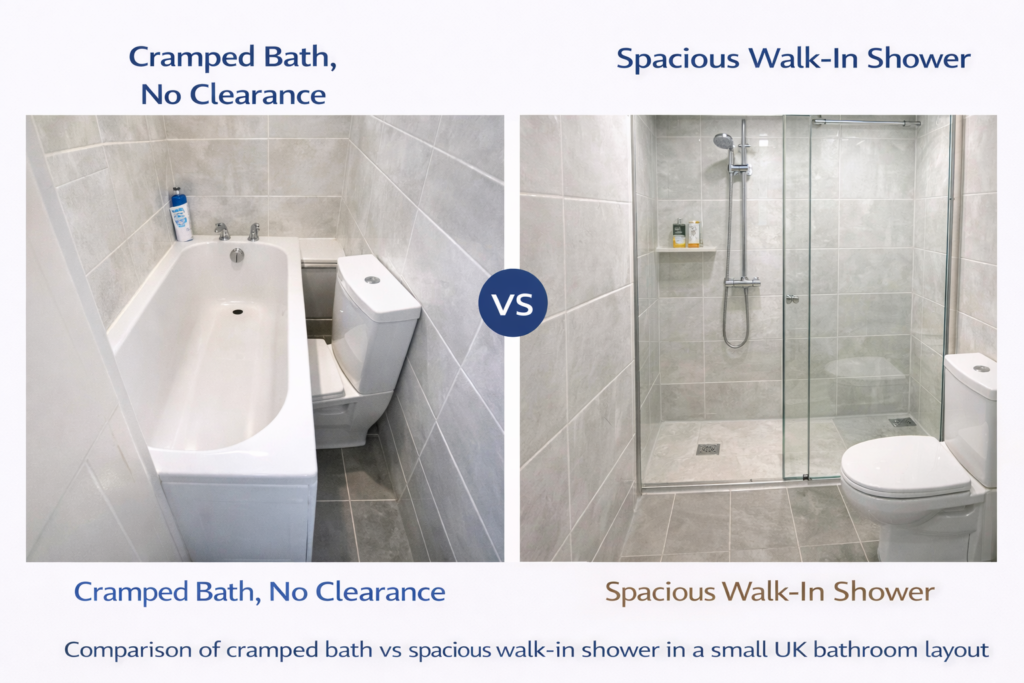
Mistake 3: Cramming a Bath Into a Space That Cannot Hold One
This is one of the most emotionally charged bathroom planning errors. The bath is a symbol of relaxation. Many homeowners feel strongly that they want one, even when their bathroom simply cannot accommodate it properly.
A standard UK bath is approximately 1,700mm long by 700mm wide. Once you add clearance space on at least one side for access, you are looking at a minimum footprint of around 1,700mm by 1,400mm just for the bath area. If your room cannot comfortably accommodate that, a well-designed walk-in shower is a smarter choice.
Walk-in showers can create the same sense of luxury and calm as a deep bath without taking up as much floor space. In many modern UK homes, a well-specified shower enclosure adds more value and usability than a squeezed-in bath.
The rule of thumb: If installing the bath means you will have less than 700mm of clearance on the access side, or it forces other fixtures into uncomfortable positions, do not install it.
Mistake 4: Ignoring Storage From the Start
Storage is always an afterthought in bathroom planning. It should be one of the first decisions you make.
As bathroom specialists, we noticed that a cluttered and disorganised bathroom feels chaotic and unappealing. The problem is that most homeowners only realise they have not built in enough storage once they are living in the finished room.
Think through what actually needs to live in your bathroom: toiletries, cleaning products, spare toilet rolls, towels, medicines and hair tools. That is a significant amount of kit. Without planned storage, it all ends up on the edge of the bath, on the windowsill or in a pile on the floor.
Smart storage solutions for UK bathrooms:
- Built-in niches in shower walls require no extra depth and deliver a very clean look.
- Wall-hung vanity units keep the floor clear and make the room feel larger.
- Mirror cabinets add storage without using any floor or shelf space.
- The void within stud walls built to support wall-hung sanitaryware can be used for flush-fitted cabinets.
One important caveat: do not overcorrect. A bathroom stuffed with too many units, shelves and baskets tips from functional into cluttered. Aim for enough storage to keep every surface clear.
Mistake 5: Placing the Towel Warmer in the Wrong Spot
This sounds like a minor detail. It is not. A badly placed towel warmer causes daily irritation and can genuinely block movement in a small bathroom.
The most common mistakes are positioning the towel warmer on the wall directly behind a door so the door cannot open fully, on a wall where it reduces the usable width of the room, or next to the shower, where it sits in the wet zone and is harder to keep clean.
Your towel warmer should be within easy reach of the shower or bath so you can grab a warm towel the moment you step out, but positioned so it does not intrude on walkway space or interfere with how doors and windows open.
In small UK bathrooms, placing the towel warmer on the wall at the end of the bath is often the most efficient position. It sits in otherwise dead space and keeps the warmer in the wet zone where warmth is most needed.
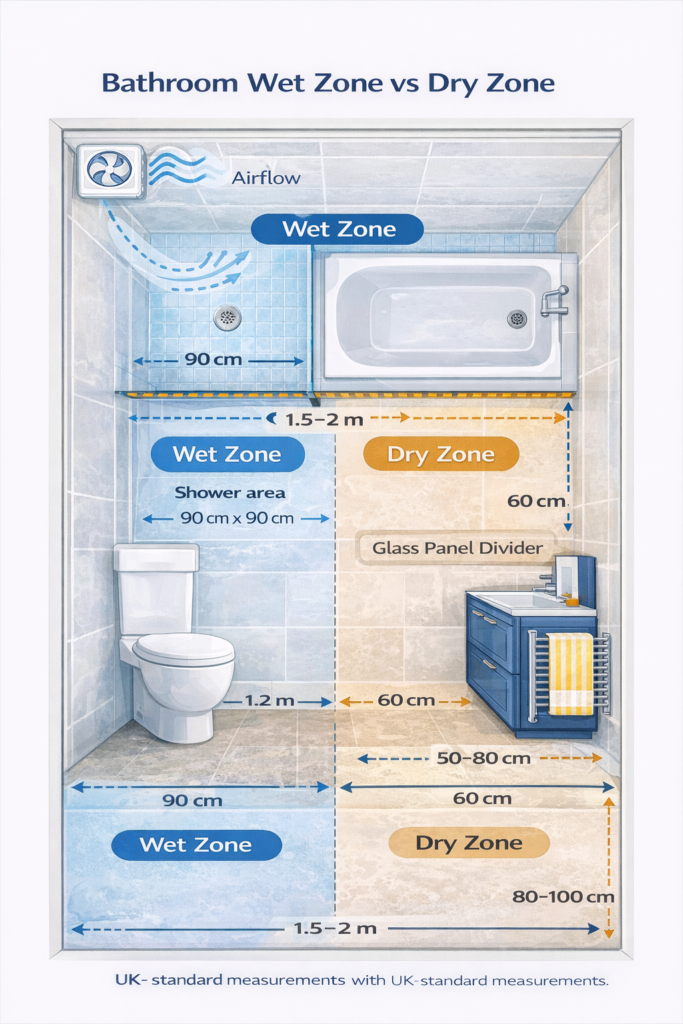
Mistake 6: Mixing Wet and Dry Zones Without a Plan
Every bathroom has a wet zone, which is the area around your shower or bath where water splashes, and a dry zone where your vanity, storage and towels sit. When these two areas overlap without any plan or separation, you end up with water damage, mould and a bathroom that always feels damp.
This is particularly common in small bathrooms where a walk-in shower sits open to the rest of the room without any form of screening. Water travels further than you expect during a shower, and a soaked floor near your vanity unit is both a slip hazard and a recipe for damage to cabinetry and flooring.
How to separate wet and dry zones:
- Use a fixed glass panel or partial screen to contain shower water without closing the room in
- Choose flooring that transitions clearly between the two zones (some homeowners use a different tile in the shower tray area)
- Make sure your shower tray or wet room floor is correctly graded toward the drain so water does not pool outside the wet zone.
- Fit an extractor fan that is powerful enough for the room size, with the standard guidance being a fan that achieves at least 15 litres per second of air extraction.
Mistake 7: Underestimating the Cost and Disruption of Moving Pipework
One of the most expensive bathroom planning errors is treating the existing pipe positions as flexible and then being surprised by the quote when your plumber explains what moving the soil stack actually involves.
We have also pointed out that if you are updating an existing bathroom, you already have drainage and water supplies in place. Moving them is possible, but it comes at a high cost and adds complexity to the project.
The best approach is to plan your layout around the existing pipe positions where possible, especially the soil stack that serves your toilet. Moving this single element can add thousands of pounds to a bathroom project.
Where plumbing does need to move for a basin or shower repositioned to improve the layout, build that cost into your budget from the start rather than treating it as an unexpected extra.
What to do: Ask your plumber to walk through the existing pipe positions with you before you finalise any layout. This one conversation can save you significant money and prevent late-stage redesigns.
Get Plumbing Services| Call +44 7852 961732
Mistake 8: Treating Lighting as a Finishing Touch
Lighting in a bathroom is not decoration. It is a functional necessity that shapes how the whole room feels and how usable it actually is.
The most common mistake is fitting a single ceiling light and calling it done. This creates harsh shadows around the mirror, which is exactly where you need clear, even light for shaving or applying makeup. It also leaves the shower feeling dim and makes a small bathroom feel even smaller.
Good bathroom lighting uses at least three layers:
- Ambient lighting is the general overhead light that illuminates the whole room.
- Task lighting is targeted light around or beside the mirror at face height.
- Accent lighting is optional but effective for highlighting features, creating atmosphere, or making the room feel larger.
LED strip lights inside mirror cabinets, spotlights positioned directly over the shower, and a well-placed main light that avoids casting shadows over the mirror are all practical improvements that a good electrician can install during a bathroom refurb.
Bathroom lighting must comply with IP ratings for use near water. All light fittings within the zones around a shower or bath require a minimum IP44 rating. Your electrician should confirm this as part of the installation.
Mistake 9: Forgetting Ventilation Entirely
Ventilation does not get talked about enough in bathroom planning guides. It is invisible, unglamorous and tends to be left to the builder or electrician without any input from the homeowner.
The consequence is mould. A bathroom without adequate ventilation will develop mould on grout lines, silicone seals and ceiling corners within months of completion. This is not just unsightly. It is a health concern and can lead to expensive remedial work.
UK Building Regulations Part F sets out ventilation requirements for bathrooms. An intermittent extract fan must provide a minimum of 15 litres per second. Continuous low-rate fans running at 8 litres per second with a boost function are increasingly preferred in modern bathroom design.
Practical advice:
- Position your extractor fan close to the shower or bath, not over the door, where it draws in air from outside the wet zone rather than from it.
- Choose a fan with a timer or humidity sensor so it runs long enough after you leave to clear the moisture properly.
- If your bathroom has a window, use it, but do not rely on it as your only ventilation.
Mistake 10: Choosing Floor Tiles That Are Not Slip-Resistant
Style choices that ignore practicality cause real harm in bathrooms. Floors get wet. Bare feet on a wet, polished tile surface are genuinely dangerous.
Porcelain tiles are hard-wearing and well-suited to high-traffic, wet environments. For shower trays and any wet zone flooring, anti-slip tiles or tiles with texture and structure for grip underfoot are essential.
This does not mean your floor has to look industrial or compromise on style. Many anti-slip tiles come in finishes that look almost identical to their smoother counterparts. The difference is in the surface texture, measured by a Pendulum Test Value (PTV) rating. A rating of 36 or above is considered low-slip risk for wet surfaces.
Ask your tile supplier for the PTV rating of any floor tile before you buy. This one question could prevent a fall.
Get Tiling and Flooring Services| Call +44 7852 961732
Mistake 11: Copying a Layout Without Measuring Your Actual Room
Pinterest boards, Instagram bathrooms and showroom displays are all designed to look beautiful. They are not designed around your specific room dimensions, window positions, door swings, soil stack location or ceiling height.
Copying a layout without measuring your actual space first leads to ordering items that do not fit, discovering mid-installation that a shower door cannot open because it hits the radiator, and finding that the beautiful vanity unit you fell in love with blocks the only window.
We always recommended: draw out a rough plan of your room on graph paper, using metric measurements, and note the location of windows, doors and existing plumbing before you make any decisions.
Better still, use a 3D bathroom planning tool or work with a bathroom designer who can model your actual space and flag conflicts before any work begins. Many bathroom retailers offer this service free of charge when you buy through them.
Bathroom Layout Clearance Quick Reference Table
| Fixture | Minimum Front Clearance | Minimum Side Clearance | Notes |
| Toilet | 700mm | 200mm each side | 900mm span is comfortable |
| Basin | 700mm | 400mm each side (800mm span) | Allow for elbows |
| Bath | 700mm one side | Access side only | 1,100mm recommended |
| Shower enclosure | 700mm from door | Not applicable | Door must open outwards |
| Door entry | 860mm clear opening | Not applicable | 610mm absolute minimum |
How Much Does It Cost to Fix a Bad Bathroom Layout?
The cost of correcting a bathroom layout mistake depends entirely on what needs changing. Moving a soil stack or repositioning a bath waste can add £500 to £2,000 or more to a project. Refitting tiles after fixing a drainage alignment error is similarly expensive. The cost of doing it properly the first time is almost always lower than the cost of putting it right later.
This is why thorough planning before any work begins is the highest-value investment you can make in a bathroom renovation.
Avoid the guesswork. Get expert bathroom advice before you commit.
Get Free Bathroom Guidance | Call +44 7852 961732
Frequently Asked Questions
What are the most common bathroom layout mistakes in UK homes?
The most common bathroom layout mistakes in UK homes are insufficient clearance space around sanitaryware, poor toilet placement in the direct sightline of the door, cramming a bath into a room too small to hold one safely, neglecting storage from the start of the planning process, and mixing wet and dry zones without any separation or screening. Bad lighting, absent ventilation and copying showroom layouts without measuring your actual room are also frequent causes of bathroom renovation regret across the UK.
Can I fit a bath in a small UK bathroom?
You can, but only if there is enough clearance space. A standard bath is roughly 1,700mm long and 700mm wide. You need at least 700mm of clear space on the long access side. If your room cannot provide this without pushing other fixtures into uncomfortable positions, a walk-in shower will serve you better.
What is the minimum bathroom size in the UK? T
There is no fixed legal minimum bathroom size in the UK. However, RIBA design guidelines recommend at least 1.8m² for a functional cloakroom and 3.5m² for a basic full bathroom with toilet, basin and bath or shower. Most UK family bathrooms sit between 4.5m² and 6.0m².
Do I need planning permission to change my bathroom layout in the UK?
Most bathroom renovations in the UK do not require planning permission as long as the structural work is internal. However, any electrical work must comply with Part P of the Building Regulations and should be carried out by a registered electrician. Plumbing work must comply with Part G and Part H. If you are in a listed building or conservation area, check with your local planning authority before starting any work.
How do bathroom layout mistakes reduce property value?
Bathroom layout mistakes reduce property value in two main ways. First, surveyors and buyers notice when a bathroom is awkward to use, poorly lit or visibly damp from inadequate ventilation, and they factor that into their offer. Second, fixing layout errors after the room is finished is expensive.
Moving a soil stack, retiling after a drainage correction or refitting cabinetry that blocks movement all cost significantly more than getting the layout right during the planning stage. Estate agents consistently rank bathrooms and kitchens as the two rooms that most influence buyer decisions in UK property sales.
How can I avoid bathroom layout mistakes before installation begins?
The most effective way to avoid bathroom layout mistakes before installation begins is to measure your room accurately and draw it to scale before you choose a single fixture. Mark every door swing, window opening and existing pipe position on your plan.
Check that your proposed layout meets the minimum clearance guidelines of 700mm in front of all sanitaryware. Use a 3D bathroom planning tool or ask a bathroom designer to model the space digitally so you can spot conflicts before any work starts. Talk to your plumber about pipe positions before finalising the layout, as moving drainage is one of the costliest changes to make mid-project.
Why do bathroom layout mistakes happen during renovations?
Bathroom layout mistakes happen during renovations most often because planning is rushed or skipped in favour of choosing tiles and finishes first. Homeowners frequently start with a visual idea they have seen online or in a showroom and try to fit it into a space it was never designed for.
Budget pressure also plays a role. When costs rise, proper planning time gets cut. Tradespeople who are brought in without a clear, agreed layout plan will make practical decisions on the spot that priorities ease of installation over long-term usability. Getting a detailed layout agreed and signed off before any work begins is the single most effective way to prevent these errors.