Choosing the right tiles can feel overwhelming. With hundreds of options across materials, sizes, finishes, and ratings, it is easy to make an expensive mistake.
The short answer: Match your tile to the room. Check the PEI rating for durability, the R rating for slip resistance, and the water absorption rate for wet areas. Then consider size, colour, and budget.
Here is a quick checklist before you buy:
- Confirm where the tile will be used (floor, wall, indoor, outdoor)
- Check PEI rating for foot traffic suitability.
- Check R rating for slip resistance.
- Confirm water absorption for bathrooms and kitchens.
- Order samples before committing
- Buy 10 to 15% extra for waste.
Ready to get started? Browse tile options and get expert advice at Best Hommes and stop guessing before you spend a penny.
Understand Where the Tiles Will Be Used
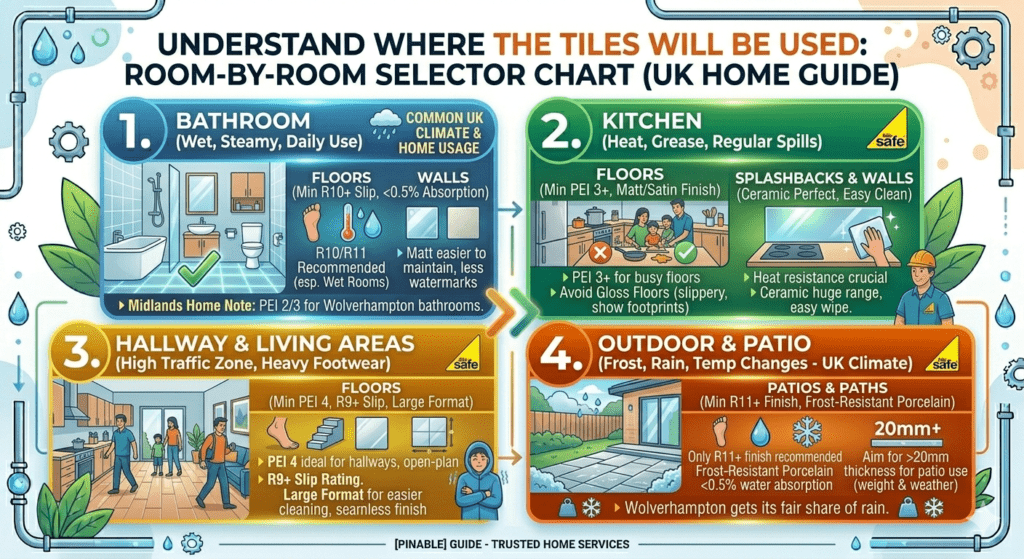
Before anything else, you need to know your room. The location dictates every decision that follows: material, rating, finish, and size.
Bathroom Tiles
Bathrooms are wet, steamy, and used daily. Slip resistance is not optional here.
For bathroom floors, you need tiles with at minimum an R10 slip rating. R10 or R11 is usually recommended for bathroom floors to reduce the risk of slipping on wet surfaces, especially in wet rooms where water is likely to pool.
For walls, any glazed ceramic or porcelain tile works well. Gloss finishes reflect light, making small bathrooms feel bigger. Matt tiles are easier to maintain without visible watermarks.
Water absorption matters too. Look for tiles with less than 0.5% water absorption for shower walls and wet room floors.
Kitchen Tiles
Kitchens face heat, grease, and regular spills. Your floor tiles need to handle all three.
Choose a porcelain floor tile with a PEI rating of at least 3. For splashbacks and walls, ceramic tiles work perfectly and come in a huge range of finishes and colours.
Avoid gloss floors in kitchens. They show every footprint and can become slippery when wet. A matt or satin finish is far more practical.
Hallways and Living Areas
These are high traffic zones. Every person who enters your home walks through them.
PEI 4 is ideal for high-traffic spaces such as kitchens, hallways, and open-plan rooms. Large format tiles also work well here. Fewer grout lines mean easier cleaning and a more seamless finish.
Opt for tiles rated R9 or higher for hallways. Scratch resistance matters too. Porcelain outperforms ceramic in this regard.
Outdoor and Patio Tiles (UK Climate)
Wolverhampton gets its fair share of rain. Your outdoor tiles need to handle frost, rain, and temperature changes throughout the year.
As the UK has a wet climate, only tiles with an R11 finish or higher are recommended for outdoor use.
Frost-resistant porcelain with a water absorption rate below 0.5% is the safest choice for patios and garden paths. Aim for a tile thickness of at least 20mm for patio use to handle weight and weather without cracking.
Choose the Right Tile Material
The material you choose affects durability, maintenance, cost, and look. Here is what you need to know about each option.
Porcelain Tiles (Best for Durability)
Porcelain is the most popular tile material in UK homes and for good reason.
Porcelain tiles account for over 60% of the UK ceramic tile market due to their superior durability. They are fired at higher temperatures than ceramics, which creates a denser, harder surface.
Key benefits:
- Water absorption below 0.5%, making them ideal for bathrooms, kitchens, and outdoors.
- Highly scratch-resistant
- Available in wood effect, marble effect, stone effect, and plain finishes
- Suitable for underfloor heating
- Very low maintenance
The downside is cost. Porcelain tiles tend to be slightly more expensive than ceramic tiles, and they require diamond-tipped tools for cutting, which can increase installation costs.
Ceramic Tiles (Budget Friendly Option)
Ceramic tiles are an excellent choice for walls and low-traffic areas. They are lighter, cheaper, and easier to cut than porcelain.
They work well as kitchen, bathroom, and splashback tiles. However, semi-vitreous tiles with a water absorption rate of 3 to 7% can work in some indoor applications, but are not ideal for bathroom or kitchen floors.
For walls, ceramic is a smart budget choice that doesn’t compromise on style.
Natural Stone Tiles
Marble, slate, and travertine bring a luxury feel to any room. They are beautiful, unique, and can add genuine value to your home.
The trade-off is maintenance. Natural stone is porous and needs sealing after installation and periodically thereafter. Without sealing, stains and moisture can cause long-term damage.
Marble floors in bathrooms look stunning but require more care than porcelain. For Wolverhampton homes where practicality matters, natural stone is best kept to feature walls or low-traffic areas.
Decorative Tiles (Mosaic, Glass, Feature Tiles)
Mosaic tiles are perfect for shower niches, splashbacks, and feature walls. The extra grout lines provide additional slip resistance, which makes them practical for wet areas.
Glass tiles add a reflective, contemporary look. They work best on walls rather than floors as they are less durable underfoot.
Feature tiles with bold patterns, encaustic cement designs, or Victorian-style prints are popular in Wolverhampton hallways and are a great way to add character without tiling an entire room.
Check Technical Ratings Before Buying
This is where most people go wrong. Buying a tile without checking its ratings is like buying a car without checking the engine. The tile might look perfect, but if the ratings do not match your space, you will regret it quickly.
What is PEI Rating?
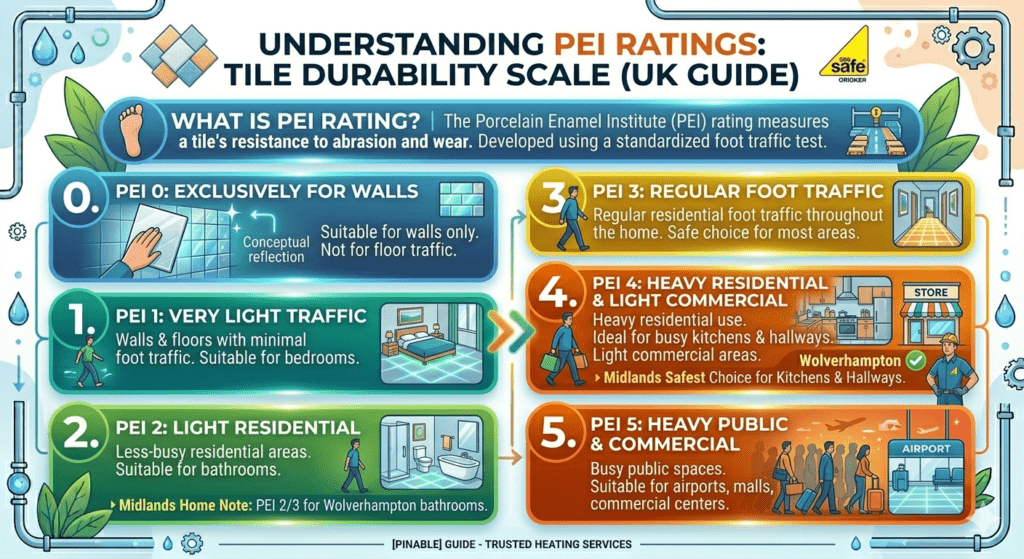
The PEI rating measures a tile’s resistance to abrasion and wear. It was developed by the Porcelain Enamel Institute using a standardized test that simulates foot traffic.
Tiles are rated on a scale of 0 to 5 for durability. PEI 0 tiles are suitable exclusively for walls. PEI 1 is suitable for walls and floors with minimal foot traffic, like bedrooms. PEI 2 is appropriate for less-busy areas, such as bathrooms. PEI 3 is for regular foot traffic throughout the home. PEI 4 is ideal for heavy residential use and light commercial areas. PEI 5 suits busy public spaces such as airports.
For most Wolverhampton homes, PEI 3 works well in bathrooms and bedrooms, while PEI 4 is the safest choice for kitchens and hallways.
| PEI Rating | Best Used For |
| 0 | Walls only |
| 1 | Bedrooms, en-suites |
| 2 | Family bathrooms |
| 3 | Kitchens, living rooms, hallways |
| 4 | High traffic homes, light commercial |
| 5 | Airports, shopping centres |
What is R Rating (Slip Resistance)?
The R rating measures a tile’s slip resistance underfoot. It is determined using a ramp test, in which a person walks on a wet, lubricated tiled surface at increasing angles.
R9 tiles are suitable for dry indoor spaces. R10 offers greater grip and is ideal for areas that may be prone to splashes and spills, such as kitchens and cloakrooms. R11- and R12-rated tiles are suitable for outdoor spaces as well as wet rooms and bathrooms. R13 is the highest level and is found around swimming pools and public showers.
| R Rating | Recommended For |
| R9 | Living rooms, bedrooms, dry hallways |
| R10 | Kitchens, bathrooms (with mat) |
| R11 | Wet rooms, bathrooms, covered patios |
| R12 | Outdoor steps, pool areas, commercial kitchens |
| R13 | Swimming pools, industrial settings |
For Wolverhampton bathrooms with children or elderly users, go for R11 as a minimum. Do not compromise safety for a smoother finish.
Tile Thickness Guide
Wall tiles are typically 6 to 10mm thick. Floor tiles range from 10 to 20mm, with outdoor patio tiles starting at 20mm.
Thicker does not always mean more durable. A glazed porcelain tile is almost always more durable than a glazed ceramic tile, but may be substantially thinner, as porcelain is fired at higher temperatures to form a robust, dense flooring material. Always check the PEI rating, not just the thickness.
Rectified vs Non-Rectified Tiles
Rectified tiles are machine-cut to a precise size after firing. This allows them to be laid with very thin grout joints (as little as 1.5mm), giving a seamless, modern look.
Non-rectified tiles have slightly uneven edges from the firing process and need wider grout lines (3mm or more) to accommodate small size variations.
For large-format tiles and contemporary designs, rectified tiles are the better choice. For traditional or rustic styles, non-rectified tiles can add charm.
Select the Right Tile Size and Layout Pattern
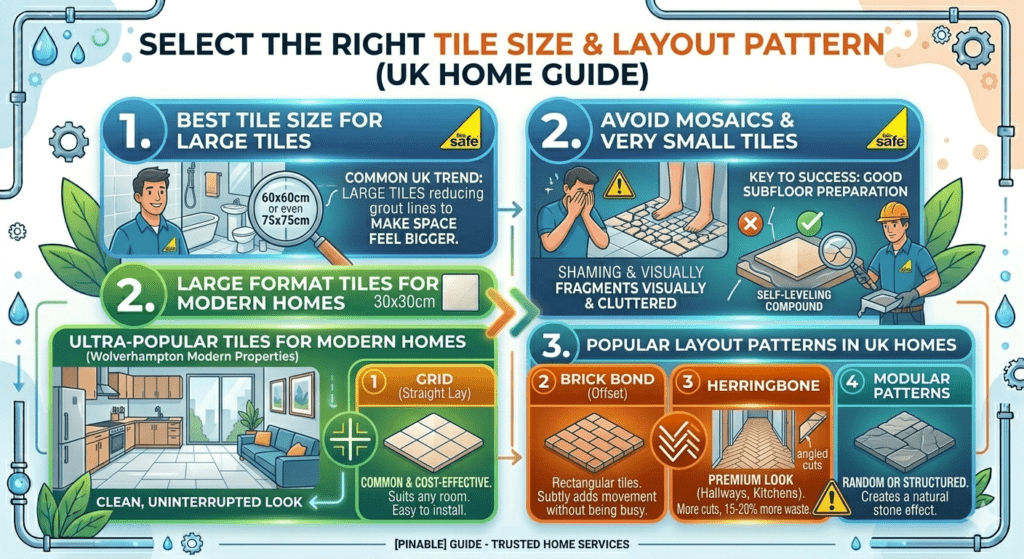
Size and layout affect how your room feels. The wrong combination can make a small space feel cramped or a large room feel busy.
Best Tile Size for Small Rooms
Large tiles in small rooms is a common trend in UK interior design right now. Contrary to what many people think, a 60x60cm or even 75x75cm tile in a small bathroom can actually make the space feel bigger by reducing the number of grout lines.
Mosaic tiles and very small tiles do the opposite. They fragment the floor visually and can make a small bathroom feel cluttered.
If you want to go classic, a 30x30cm tile is a safe and practical option for smaller rooms.
Large Format Tiles for Modern Homes
Large format tiles (60x60cm and above) are extremely popular in Wolverhampton’s modern and newly renovated properties. They create a clean, uninterrupted look that works beautifully in open-plan kitchens and living areas.
The key is good subfloor preparation. Large tiles magnify any floor imperfections. A professional installer will use a self-leveling compound if needed before laying large-format tiles.
Popular Layout Patterns in UK Homes
The pattern you choose affects both the look and the cost. More complex patterns take longer to lay and can increase material waste.
Grid (Straight Lay): The most common and cost-effective. Tiles are laid in straight rows, aligned horizontally and vertically. Easy to install and suits any room.
Brick Bond (Offset): Each row is offset by half a tile, like brickwork. Works especially well with rectangular tiles and adds subtle movement without being busy.
Herringbone: Rectangular tiles laid at 45 or 90 degrees in a V-shape. A premium look, popular in hallways and kitchens. Herringbone tiling requires more cuts than standard layouts, and angled cuts generate 15-20% more waste, increasing material costs. Budget accordingly.
Modular Patterns: Multiple tile sizes combined in a random or structured layout. These create a natural stone effect and work well with travertine and slate-style tiles.
Grout width advice: Use 1.5-3mm for rectified tiles and 3-5mm for non-rectified tiles. Wider grout lines suit rustic and patterned styles. Narrower joints create a sleek, contemporary finish.
Choose Tile Colour and Finish
Once the technical decisions are made, the fun begins. Colour and finish are where your personal style comes into play.
Gloss vs Matt Tiles
Gloss tiles reflect light, making rooms feel brighter and bigger. They are popular for bathroom walls and kitchen splashbacks, but show fingerprints and watermarks more easily.
Matt tiles are far more practical for floors. They hide dirt better between cleans, are less slippery, and suit a wider range of interior styles.
Satin or semi-polished finishes offer a middle ground. They have a subtle sheen without the high maintenance of full gloss.
Light vs Dark Tiles
Light tiles (whites, creams, light greys) make rooms feel open and airy. They are especially effective in bathrooms with limited natural light, which is common in many Wolverhampton terraced homes.
Dark tiles create drama and warmth. Deep charcoal, slate, or navy blue tiles work well as feature walls or in larger rooms where they will not overwhelm the space.
Tiles That Make a Room Look Bigger
If you want to visually enlarge a space, follow these rules:
- Use large-format tiles to reduce grout lines.
- Choose light, neutral colors
- Lay tiles diagonally to draw the eye outward.
- Keep wall and floor tiles in the same colour family.
- Use gloss or polished finishes on walls to reflect light.
Matching Tiles with Your Interior Style
Contemporary homes suit large format porcelain in concrete grey, warm beige, or soft white. Industrial styles work well with textured slate-effect or raw stone finishes. Traditional homes benefit from classic white metro tiles, encaustic patterns, or natural stone.
Budget Planning and Tile Costs in Wolverhampton
Being clear on your budget before you walk into a tile showroom saves a lot of time and prevents overspending.
Tile Cost Per m2 in the UK (2026)
You will pay somewhere around £15 to £25 per m2 for a ceramic tile and around £40 to £50 per m2 for a marble tile.
Here is a quick overview of tile material costs:
| Tile Type | Average Cost Per m2 |
| Ceramic | £15 to £25 |
| Porcelain | £20 to £50 |
| Natural stone (slate, travertine) | £40 to £80 |
| Marble | £40 to £245 |
| Glass | £60 to £160 |
Installation Costs in Wolverhampton
The average floor tiling cost in the UK is £110 per m2, including standard tiles, materials, and labour. The average cost of tiling a bathroom, including walls and floors, is between £800 and £1,200.
Labour alone typically costs £20 to £40 per m2, depending on complexity. Intricate patterns like herringbone cost more due to the skill and time required to create them.
Always purchase 10 to 15% more tiles than your measurements indicate to account for cuts, breakage, and future repairs.
Underfloor Heating Compatibility
Porcelain tiles are excellent heat conductors and work well with underfloor heating systems. Natural stone also conducts heat well. Thick ceramic tiles are less efficient.
If you are installing underfloor heating, mention it to your tile supplier. They can confirm whether your chosen tile is suitable and advise on the correct adhesive.
Common Mistakes to Avoid When Choosing Tiles
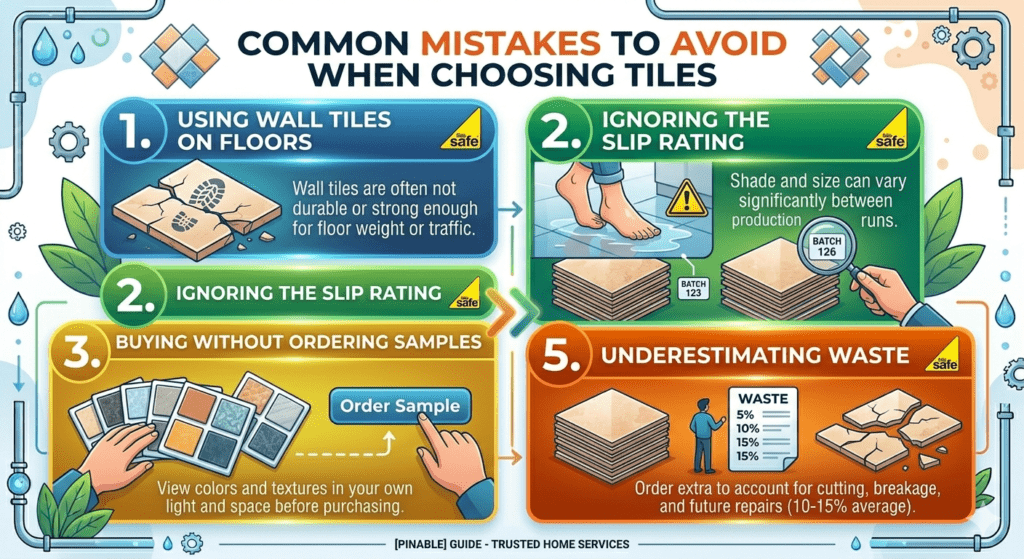
Learning from other people’s tiling errors saves you money and stress.
- Using wall tiles on floors. Wall tiles are not designed for foot traffic. They are thinner, have a higher water absorption rate, and will crack or wear quickly under load. Always check the PEI rating to confirm floor suitability.
- Ignoring the slip rating. This is a safety issue, not just a preference. Smooth, polished tiles with an R9 rating on a bathroom floor are a genuine hazard, particularly with children or elderly family members in the home.
- Buying without ordering samples. Tile colours look very different on a screen than they do in your actual room under your lighting conditions. Always order samples and view them in the space before committing to a full order.
- Not checking batch numbers. Tiles are produced in batches. Different batches can have very slight colour or shade variations. Always buy all the tiles you need from the same batch number. If you need extra tiles later, the batch may no longer be available.
- Underestimating waste. Measure your room carefully, then add 10-15% for waste. If you are using a herringbone or diagonal layout, add up to 20%, as these patterns require more cuts.
Tile Buying Checklist
Use this before placing any tile order:
- Confirm the room and its usage (floor, wall, wet area, outdoor)
- Check PEI rating matches the foot traffic level.
- Check R rating is appropriate for moisture and safety.
- Confirm water absorption rate for bathrooms and outdoor areas.
- Verify frost resistance for any outdoor tiles.
- Order physical samples and view them in the room.
- Calculate your area accurately and add 10 to 15% waste allowance.
- Check that all tiles are from the same batch number.
- Confirm underfloor heating compatibility if applicable.
- Get at least two installation quotes before committing.
Get a free consultation with our tiling experts at Best Hommes to ensure every tile you buy is the right one.
Where to Buy Quality Tiles in Wolverhampton
Wolverhampton has a range of tile suppliers from large national showrooms to independent specialists. When choosing a supplier, look for:
A physical showroom. Being able to see and feel tiles in person before buying is invaluable. Colours and textures look very different online compared to in your home.
Technical knowledge. Good tile suppliers will ask about your room, usage, and requirements before recommending products. If a supplier just shows you products without asking questions, go elsewhere.
Batch stock availability. Make sure the supplier can provide enough tiles from a single batch to cover your full project, plus your waste allowance.
Sample service. Any reputable supplier will offer tile samples. This is not optional. Always see the tile in your space under your own lighting before ordering.
Questions to ask before purchasing:
- What is the PEI rating of this tile?
- What is the R rating for slip resistance?
- Is this tile frost-resistant?
- Is it compatible with underfloor heating?
- Can you confirm the batch number and stock availability?
- What waste percentage do you recommend for my layout?
For trusted guidance on flooring, tiling, and home improvement across Wolverhampton and the West Midlands, visit Best Hommes, where our team is ready to help you make the right choice for your home.
FAQs
Which tiles are best for high-traffic homes in the UK?
Porcelain tiles with a PEI rating of 4 are the best choice for high-traffic homes. They are dense, highly scratch-resistant, and have a water absorption rate below 0.5%. They suit kitchens, hallways, and open plan living areas and maintain their finish far longer than ceramic alternatives under heavy daily use.
Are porcelain tiles better than ceramic tiles?
For floors and wet areas, yes. Porcelain is denser, harder-wearing, and has far lower water absorption than ceramic. Ceramic tiles are perfectly suitable for walls and low-traffic areas, where they offer good value for money. For outdoor use or high-traffic floors, porcelain is always the stronger choice.
What tile finish is easiest to clean?
Matt and satin finish tiles are the most practical for everyday cleaning. They hide footprints, smears, and watermarks far better than gloss. Gloss tiles show every mark between cleans, which can make maintaining a tidy appearance more demanding, especially in kitchens and family bathrooms.
Can I use the same tiles throughout my house?
Yes, and it is a great way to create a sense of space and flow, especially in open-plan layouts. Make sure the tile you choose has a PEI rating suitable for every room it will be used in. A tile rated PEI 4 can be safely used throughout the home, from bathrooms to hallways to living areas.
What tiles add value to a home in Wolverhampton?
Porcelain tiles in neutral tones, large-format designs, and high-quality natural stone finishes are most likely to impress buyers and add perceived value. Consistent tiling throughout living areas and well-chosen bathroom tiles with good slip ratings also signal quality to potential buyers during viewings.