
Winter heating preparation in Wolverhampton is not optional. January temperatures in the city regularly drop to around 1.4°C overnight, with average highs of just 6.1°C. Snow arrives from November and can persist into March. Your heating system carries the full weight of that for months on end.
The problem is not the cold itself. It is arriving at the first cold morning of October and finding a boiler that will not fire, radiators with dead spots and pipes that should have been insulated weeks ago.
This guide gives you a practical, step-by-step winter heating checklist built on verified UK data and Gas Safe standards. Follow it and you stay warm, stay safe and cut your energy bills at the same time.
Quick pre-winter checklist at a glance:
- Book annual boiler service with a Gas Safe engineer
- Test the heating system fully before temperatures drop
- Bleed all radiators and check boiler pressure
- Insulate the external condensate pipe
- Test carbon monoxide and smoke alarms
- Review thermostat settings and heating schedule
- Draught-proof doors, windows and skirting boards
Book your pre-winter boiler service in Wolverhampton now. Use the Gas Safe Register to find a qualified local engineer by postcode.
Why Winter Heating Preparation Matters in the UK
Cold homes are a health issue before they are a comfort issue. Evidence shows that exposure to temperatures at or below 18°C is linked to negative effects on heart and lung health, sleep and physical performance, with older people and those with long-term conditions at higher risk. UK health authorities now advise keeping homes at a minimum of 18°C, with particular emphasis on protecting vulnerable groups during cold spells.
Beyond health, there is the cost of getting it wrong. Emergency boiler callouts during winter peak periods carry a significant premium, often two to three times the cost of a planned annual service. Regular boiler servicing helps reduce energy bills by keeping the system running as efficiently as possible, meaning you pay less for the same warmth every single day of winter.
Preparation done in late summer or early autumn is always cheaper, quicker and less stressful than scrambling for an engineer in November.
When to Start Your Winter Heating Prep
The ideal window is July to September. Engineers across the West Midlands are less busy during this period, so you get faster appointments and often better prices.
The cheapest time of year to service a boiler is summer, because Gas Safe engineers do not have as much work on in the warmer months when people are not turning their heating on.
By October, that changes quickly. Demand rises sharply, lead times stretch out and you may wait weeks for an appointment. If your boiler develops a fault during that wait, you are exposed to the cold without a fallback.
If you have already passed the summer window, do not delay further. An early autumn service still leaves you well protected before Wolverhampton temperatures become punishing.
Step-by-Step Winter Heating Checklist for Wolverhampton Homes
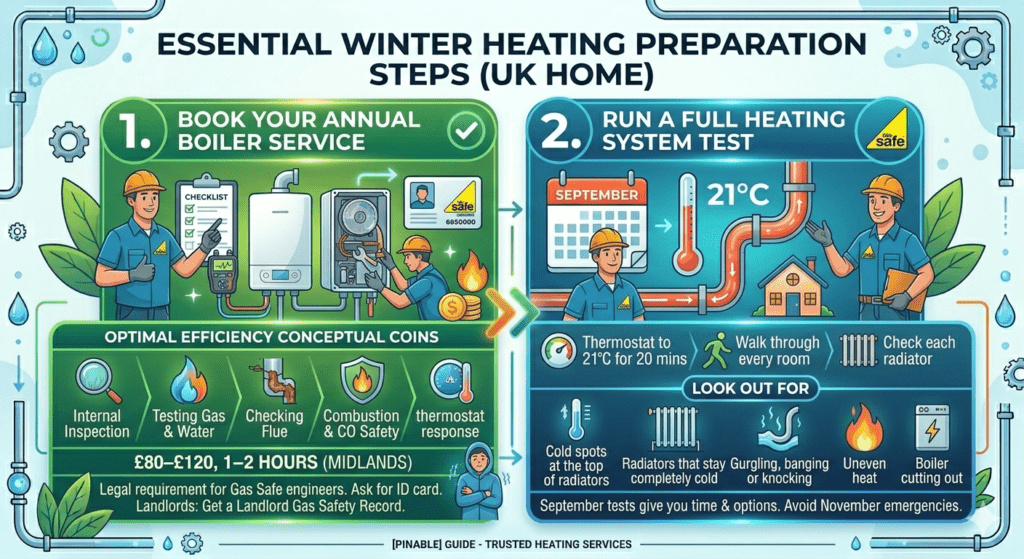
1. Book Your Annual Boiler Service
This is the most important item on this list. A Gas Safe registered engineer will carry out a thorough inspection that goes well beyond a visual check.
During a standard UK boiler service, the engineer will:
- Inspect all internal components for wear, corrosion and leaks
- Check and clean the burner, injector and heat exchanger
- Test gas pressure and water flow through the system
- Examine the flue for blockages or damage
- Run combustion and carbon monoxide safety checks
- Test ignition, thermostat response and all controls
- Issue a signed service record on completion
A standard annual boiler service costs around £80 to £120 across the Midlands and takes approximately one to two hours to complete.
It is a legal requirement that all gas boiler work in the UK is carried out by a Gas Safe registered engineer. Being on the Gas Safe Register proves that the engineer has passed an industry recognised accredited gas qualification and holds a licence to work legally on gas appliances in the UK. Always ask to see the engineer’s Gas Safe ID card before any work begins.
Landlords have an additional legal duty. The only documentation required by law is a Landlord Gas Safety Record, and landlords must provide tenants with a copy once it has been completed by a registered engineer.
2. Run a Full Heating System Test
Before you need the heating in earnest, give it a full test run. Set the thermostat to 21°C and let the system run for 20 minutes. Walk through every room and check each radiator.
Look out for:
- Cold spots at the top of radiators, which signal trapped air
- Radiators that stay completely cold
- Gurgling, banging or knocking from pipes or the boiler unit
- Uneven heat across radiators on the same floor
- The boiler cutting out before reaching temperature
Catching these faults in September gives you time and options. Catching them in November gives you neither.
Essential Maintenance Tasks
Check and Stabilise Boiler Pressure
Your boiler pressure gauge is on the front of the unit. For most UK homes, correct pressure sits between 1.0 and 1.5 bar when the heating is off. When the system is running, it naturally rises to around 2 bar.
If pressure drops below 1 bar regularly, the boiler may shut down to protect itself. If it climbs above 2.5 bar consistently, bleed your radiators to release trapped air first before adjusting further. Pressure that drops repeatedly without explanation needs a Gas Safe engineer to investigate, as it can indicate a slow leak in the system.
Bleed Your Radiators
Bleeding removes trapped air that prevents hot water circulating fully, causing cold spots and making your boiler work harder than necessary. It is a simple job every homeowner can do.
How to bleed a radiator:
- Turn the heating on and let all radiators warm up fully
- Identify which ones feel cold at the top but warm at the bottom
- Switch the heating off and wait for the system to cool down
- Place a cloth or small container under the bleed valve, located at the top corner of the radiator
- Insert a radiator bleed key and turn it slowly anti-clockwise, no more than half a turn
- You will hear hissing as trapped air escapes
- Close the valve as soon as water begins to flow, which means all air has been released
- Work from radiators furthest from the boiler towards it
- Once all radiators are bled, check boiler pressure and top it up to between 1.0 and 1.5 bar if needed
- Turn the heating back on and confirm even warmth across all radiators
A bleed key costs under £5 from any hardware store and should be kept in every UK home.
Prevent Frozen Condensate Pipes
The condensate pipe is the small plastic pipe that exits the boiler, passes through the external wall and connects to an outside drain. Any exposed section outside is vulnerable when temperatures fall below zero, which they regularly do in Wolverhampton from December through February.
When a condensate pipe freezes, the boiler locks out entirely and will not fire until the blockage is cleared.
To prevent this:
- Wrap all external sections with foam pipe insulation, available from DIY stores for around £10
- Ask your engineer whether a shorter external run or internal rerouting is practical
If the pipe does freeze, pour warm water along the frozen section to thaw it. Never use boiling water as this can crack the plastic pipe and cause more expensive damage. Once thawed, fit or refit insulation and reset the boiler.
Thermostats, Controls and Heating Schedules
Your heating controls directly affect how much energy your system uses every day of winter. Even a well-serviced boiler wastes money if the controls are set incorrectly.
Before winter arrives, check that your programmable thermostat displays the right time and day, and that your heating schedule still reflects how you actually use your home. Set the heating to come on around 30 minutes before you wake up and switch off 30 minutes before you leave for the day.
Thermostatic radiator valves (TRVs) on individual radiators let you dial down heat in rooms you rarely use, such as a spare bedroom or utility room. This alone can produce meaningful savings across a long UK winter.
For a more significant upgrade, smart thermostats such as Hive, Nest or Tado connect to your smartphone and learn your routine automatically. They are compatible with most UK combi boilers and can be installed by a Gas Safe engineer in under an hour. According to data from the Energy Saving Trust, smart thermostats combined with good heating controls can deliver savings of around 12% on annual gas consumption compared to a basic setup.
Energy Efficiency and Insulation Tips
Heating your home efficiently means stopping heat from escaping as much as generating it in the first place. These low-cost steps compound the work your boiler is already doing.
Draught proofing
The Energy Saving Trust advises that eliminating draughts through proper door and window sealing could save around £85 a year off your energy bill. Foam draught seal strips cost between £3 and £5 per roll and take minutes to apply. Check around skirting boards, loft hatches and anywhere pipework passes through external walls.
Boiler flow temperature
Most UK combi boilers leave the factory set to circulate water at around 75°C to 80°C. This is higher than most homes actually need. Reducing the boiler flow temperature from 80°C to 60°C can cut gas use by up to 9%, and dropping it to 55°C could save as much as 12%, without sacrificing warmth or comfort in the home. This single change is free to make and takes two minutes.
Radiator reflector panels
Radiators on external walls lose a proportion of their heat into the wall behind them. Reflective foil panels fitted behind the radiator redirect that heat into the room. They cost around £10 to £20, require no tools and are available at most UK DIY retailers.
Loft insulation
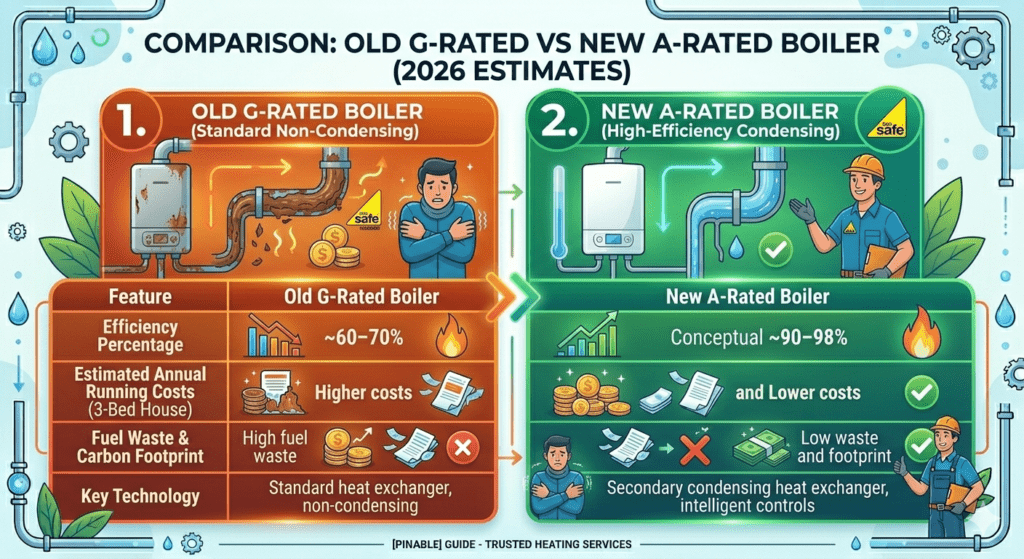
The recommended depth of mineral wool loft insulation in England is 270mm. Replacing an old G-rated boiler with a new A-rated condensing boiler, combined with good controls, can save up to £490 a year for a detached house, according to the Energy Saving Trust. Even without a new boiler, topping up loft insulation to the recommended depth reduces the amount of heat your system has to replace throughout the day.
Safety Checklist for Winter Heating
A warm home must also be a safe one. These checks are quick and non-negotiable before winter arrives.
Carbon monoxide detector
Carbon monoxide has no smell, taste or colour, yet even low-level exposure causes serious harm. If an engineer carries out gas work without being Gas Safe registered, they are working illegally and could put you at risk of gas leaks, fires, explosions and carbon monoxide poisoning. For this reason, always verify your engineer before any work begins.
Under the Smoke and Carbon Monoxide Alarm (Amendment) Regulations 2022, landlords in England are legally required to install a CO alarm in any room containing a fixed combustion appliance. For owner-occupiers, it is equally important. Test the alarm monthly using the test button and replace any unit that is over seven years old or fails to sound.
Smoke alarms
Test every smoke alarm in the property. Replace batteries if needed. Ensure you have a working alarm on every floor with a living space.
Flue and vent checks
Ask your engineer to inspect the external flue during the annual service. Debris, leaves and bird nests can accumulate over summer and restrict airflow, creating a carbon monoxide risk inside the home. Never block or cover any vent or flue yourself.
Boiler cupboard clearance
Ensure the space around your boiler is clear of boxes, cleaning products and stored items. Good airflow around the unit is essential for safe and efficient combustion.
| Safety Check | How Often | Who Carries It Out |
| Carbon monoxide alarm test | Monthly | Homeowner or tenant |
| Smoke alarm test | Monthly | Homeowner or tenant |
| Full boiler service and flue check | Annually | Gas Safe registered engineer |
| Landlord Gas Safety Certificate | Annually | Gas Safe registered engineer |
| Condensate pipe insulation check | Before first cold snap | DIY or engineer |
Common Winter Heating Mistakes to Avoid
Booking too late. By October, Gas Safe engineers across Wolverhampton and the wider West Midlands are stretched. Waiting until the cold arrives means longer wait times, less availability and no safety net if a fault emerges.
Ignoring early warning signs. Unusual boiler noises, radiators slow to heat up and pressure that drops repeatedly are early faults that cost far less to fix before a breakdown than after one.
Skipping the condensate pipe. Many households only discover the pipe has frozen on the morning the boiler will not start, which is the worst moment to deal with it. Ten minutes and £10 of insulation prevents this entirely.
Forgetting to review heating schedules. If your daily routine has changed since last winter, your programmed schedule may no longer match how you use the house. Spend five minutes reviewing it before the season begins.
Wolverhampton-Specific Advice
Wolverhampton sits at around 152 metres above sea level and sees genuine winter conditions from late October through to March. Many homes across Penn, Wednesfield, Bloxwich and the town centre are pre-1960 builds with solid walls rather than cavity walls, meaning heat loss is higher than in newer properties.
If you rent your home, your landlord is legally required to provide an annual Gas Safety Certificate. If you have not received one, contact your landlord in writing. Under the Homes (Fitness for Human Habitation) Act 2018, landlords must maintain a heating system that keeps the property safe and habitable throughout the year.
As a renter you can still bleed your own radiators, test CO detectors and draught-proof doors and windows. You should report any boiler faults or heating problems to your landlord promptly and in writing so there is a clear record.
For energy efficiency advice and information on grants that may be available in your area, the Energy Saving Trust is the most reliable independent source in the UK.
If you want authoritative UK health guidance on keeping your home warm and safe, the UK Health Security Agency Cold Weather Advice provides clear recommendations backed by medical research.
Get ahead of the winter rush. Visit besthommes.co.uk for more home heating guides, insulation advice and energy-saving tips built for UK homeowners.
Frequently Asked Questions
What is the best time to prepare heating for winter in Wolverhampton?
The best time is between July and September. Engineers are less busy in summer, making it easier to book quickly and at a better price. This window also gives you time to fix any faults before October temperatures begin dropping across Wolverhampton and the West Midlands.
How often should a boiler be serviced?
Once every year, ideally in late summer before the heating season begins. Annual servicing keeps the boiler running safely and efficiently, maintains most manufacturer warranties and is a legal requirement for landlords in England who must issue tenants with a Gas Safety Certificate.
Why is radiator bleeding important before winter?
Radiators collect trapped air over time, which stops hot water circulating fully and creates cold spots. This forces the boiler to work harder and longer to reach the set temperature, which pushes up energy bills. Bleeding takes under 30 minutes and makes a noticeable difference to both warmth and running costs.
Should I insulate condensate pipes in Wolverhampton?
Yes. Wolverhampton temperatures regularly fall below zero in January and February. Any exposed external section of a condensate pipe can freeze in these conditions and lock out the boiler completely. Foam pipe insulation costs around £10 from any DIY store and takes minutes to fit, making it one of the highest-value tasks on this list.
What boiler pressure is correct for a UK home?
For most UK homes, the correct boiler pressure is between 1.0 and 1.5 bar when the system is switched off. When running, pressure naturally rises to around 2 bar. If pressure drops below 1 bar or rises above 2.5 bar consistently, contact a Gas Safe registered engineer rather than continuing to adjust it yourself.


