Choose a plastering and rendering company with verified local experience across WV1–WV14, solid Google and Checkatrade reviews, public liability insurance, and transparent written quotes. Always confirm they understand Wolverhampton’s property types — from Victorian terraces in Tettenhall to modern builds in Perton. Get at least three written quotes before committing.
Quick checklist:
- Local Wolverhampton experience (5+ years)
- Verified customer reviews on Google, Checkatrade or Trustpilot
- Public liability insurance (minimum £2 million)
- CSCS certification and manufacturer-approved credentials
- Written quote with full breakdown
Get Free Rendering Quote | Call +447852961732
Introduction
Your walls are one of the first things people notice about your home. Poor plastering or rendering does not just look bad — it lets in damp, causes cracking, and can reduce your property value overnight.
Wolverhampton homeowners face a real challenge here. The market is full of contractors, but finding one with genuine local expertise, proper credentials, and honest pricing takes time and knowledge.
This guide cuts through the noise. It covers everything you need to know — from render types and 2026 pricing to red flags and building regulations — so you can hire with confidence.
Why Choosing the Right Rendering Company Matters
The difference between a good plasterer and a bad one is not always visible on day one. It shows up months or years later, when cracks appear, damp seeps in, or render starts to hollow and fall away.
Common Problems from Poor Contractors
Getting this wrong is expensive. Here is what poor artistry typically leads to:
- Cracking render due to incorrect mix ratios or skipped preparation
- Damp penetration through poorly sealed or hollow plaster
- Short lifespan requiring re-rendering within 5 years
- Non-compliance with building regulations, which causes problems when selling
- Hollow plaster that sounds drum-like when tapped and needs full removal
Benefits of Hiring a Professional
A skilled, properly insured plastering and rendering company delivers:
- Durability of 20 to 30+ years, depending on render type
- Full weather resistance suited to the West Midlands climate
- Improved kerb appeal and property value
- Compliance with Wolverhampton Building Control requirements
What to Look for in a Plastering & Rendering Company
1. Local Experience in Wolverhampton
Local knowledge is not just a nice bonus — it is essential. A contractor familiar with WV1 to WV14 understands the structural quirks of local properties, knows reliable local suppliers, and has already solved the problems your home is likely to present.
Wolverhampton has a diverse housing stock. Each area has its own challenges:
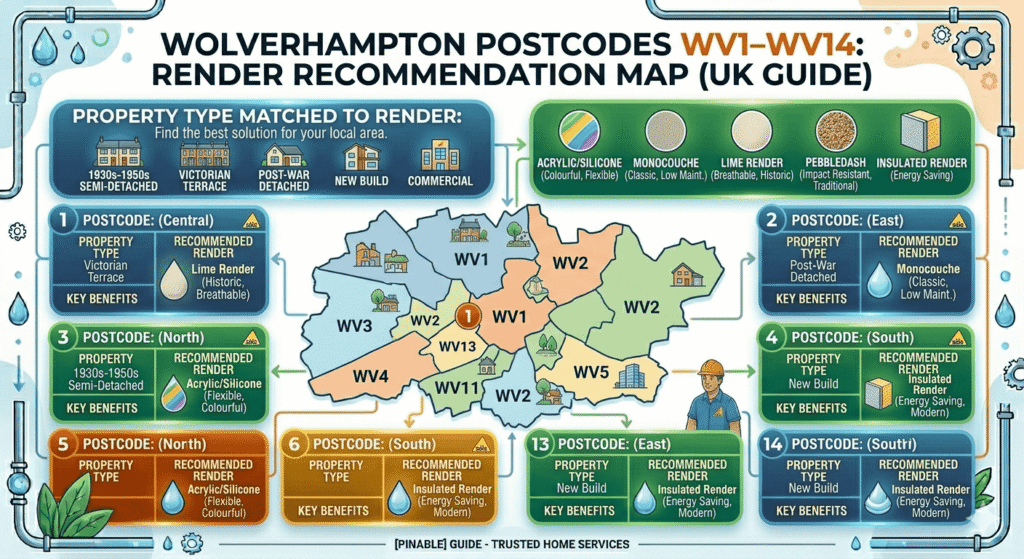
- Victorian and Edwardian terraces (Tettenhall, Compton): Solid brick construction, often with original lime mortar. Needs breathable render systems, not modern impermeable products that trap moisture.
- 1930s semis (Penn, Finchfield): Cavity walls and larger surface areas. Suitable for a wider range of render types but requires proper preparation.
- Modern builds (Perton, Codsall): Block construction with tight tolerances. Clean monocouche or silicone renders work well here.
Ask your contractor directly: how many jobs have you completed in this postcode? Can you show examples from Tettenhall, Penn, or Wednesfield? Weak answers are a warning sign.
2. Verified Reviews and Reputation
Online reviews are the closest thing you have to a personal recommendation from a stranger. Use them properly.
Where to check:
- Google Business Profile reviews with verified location
- Checkatrade, which vets tradespeople and verifies reviews
- Trustpilot verified reviews
- Rated People project feedback
What to look for in reviews:
Do not just count stars. Read the comments. You want to see repeated mentions of work completed on time, clean sites, fair pricing, and good communication when problems arose.
Be cautious of profiles with only glowing 5-star reviews and no details. Authentic contractors attract a mix of responses, and good ones respond professionally to criticism.
Request the contact details for two or three recent customers in Wolverhampton, then call them. It takes ten minutes and reveals more than fifty reviews.
3. Insurance and Certifications
This is non-negotiable. Always verify before work starts.
Essential insurance:
- Public liability insurance (minimum £2 million)
- Employer’s liability insurance if they use subcontractors
Key certifications:
- CSCS card — confirms the plasterer has been assessed for competence
- Manufacturer-approved installer status for silicone or monocouche render systems
- TrustMark registration — a government-endorsed quality scheme for home improvement tradespeople
Ask to see the current proof. Expired policies leave you legally exposed if something goes wrong on your property.
4. Understanding Render Types
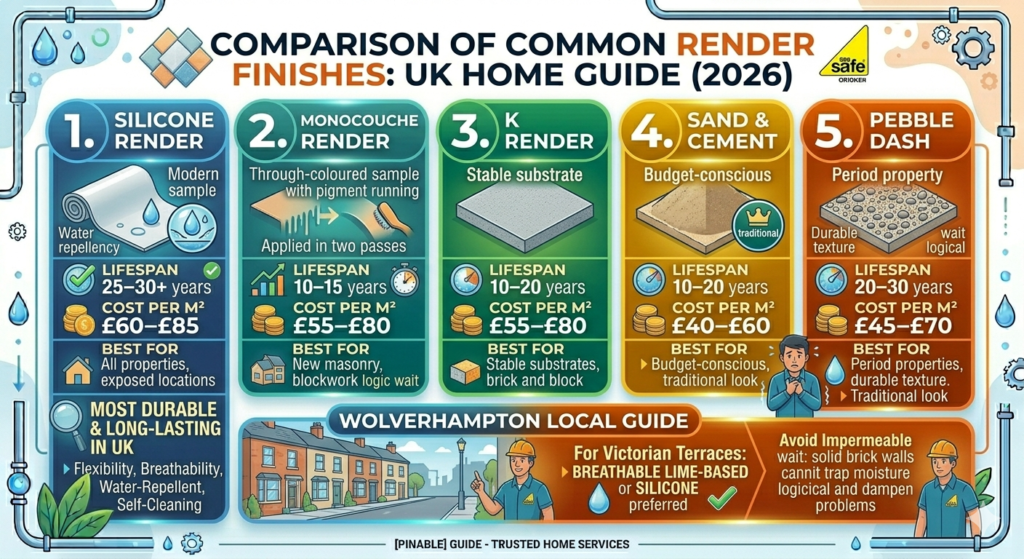
Not all renders are the same. The right choice depends on your property type, budget, and the level of maintenance you want to carry out. Here is a clear comparison:
| Render Type | Lifespan | Cost Per m² (2026) | Best For |
| Silicone Render | 25–30+ years | £60–£85 | All property types, exposed locations |
| Monocouche | 10–15 years | £55–£80 | New masonry, blockwork |
| K Render | 10–20 years | £55–£80 | Stable substrates, brick and block |
| Sand & Cement | 10–20 years | £40–£60 | Budget-conscious, traditional look |
| Pebble Dash | 20–30 years | £45–£70 | Period properties, durable texture |
Silicone render is currently considered the most durable and long-lasting render system in the UK, known for its flexibility, breathability, water-repellent properties, and self-cleaning surface.
Monocouche render is through-coloured, meaning the pigment runs throughout the material, providing a long-lasting colour without the need for painting. It is applied in two passes and is suitable for masonry, brick, blockwork, and concrete.
For Victorian terraces in Wolverhampton, breathable lime-based or silicone systems are usually preferable. Impermeable renders on solid brick walls can trap moisture and cause long-term damp problems.
5. Transparent Written Quotes
A verbal quote is not a quote. It is a conversation. Always insist on a written, itemised document before any work begins.
A proper written quote must include:
- Surface preparation work (cleaning, removal of old render, priming)
- Scaffolding cost or confirmation that it is included
- Specific materials and brands are being used
- Mesh reinforcement details where applicable
- Start date and estimated completion timeline
- Workmanship guarantee duration
- Payment schedule and terms
Warning signs to watch for:
- Round numbers with no breakdown (e.g. “£5,000 for the lot”)
- No material specification
- No mention of preparation work
- Vague timeline (“a few weeks”)
- Request for more than 30% upfront
Get at least three written quotes and compare what is included — not just the bottom line. The cheapest option often omits preparation or scaffolding, which are added later.
6. Warranty and Guarantees
Any professional plastering or rendering company should back their work in writing.
What to expect:
- Workmanship guarantee of at least 5 years
- Manufacturer-backed product warranty (silicone render manufacturers typically offer 10–25 years when installed by an approved contractor)
- Written contract covering the scope of work, materials, timeline, and what happens if problems arise
If a contractor is reluctant to provide written guarantees, walk away. It signals a lack of confidence in their own work.
Red Flags to Avoid
Unrealistically Cheap Quotes
If one quote is 40% lower than all others, investigate hard before proceeding. Very low pricing typically means one of the following: unqualified or inexperienced labour, inferior materials, skipped surface preparation, or a plan to add charges for “extras” once work has started.
Quality rendering is skilled, physical work. Experienced tradespeople charge appropriate rates.
Large Upfront Deposits
A professional contractor will ask for a reasonable deposit — typically 10% to 30% — to cover initial materials. Anything beyond 30% before work starts is a risk. Some rogue traders take large deposits and disappear or do minimal work.
No Local Projects to Show
Any contractor working regularly in Wolverhampton should be able to point you to completed local jobs. If they cannot provide references or nearby examples, treat that as a significant concern.
Poor Communication
How a contractor communicates before they start tells you everything about how they will communicate during the job. Slow responses, vague answers, or pressure to decide quickly are all warning signs.
No Written Contract
Never start work without a signed written agreement. It protects both parties. Contractors who avoid contracts lack accountability.
Cost of Plastering & Rendering in Wolverhampton (2026)
Here is a realistic breakdown of current pricing based on UK market data.
External Rendering Cost Per m²
External rendering in 2026 ranges from £40 to £85 per m², depending on render type. Silicone render averages £60 to £85 per m², while traditional sand and cement sits at £40 to £60 per m².
Full House Rendering Cost
A typical three-bedroom semi-detached house costs between £5,000 and £9,000 to render completely, including scaffolding. This assumes 80 to 100m² of wall area using monocouche render on surfaces in reasonable condition. Insulated render systems (EWI) are more expensive, typically ranging from £8,000 to £14,000.
Internal Plastering Cost Per Room
For standard indoor plastering, UK rates typically range from £15 to £40 per m² for gypsum plastering with standard preparation, rising to around £55 per m² where extra preparation is needed. A typical 4m x 3m bedroom, fully plastered, costs between £450 and £700.
Factors That Affect Pricing
- Condition of existing render or plaster (preparation adds cost)
- Scaffold requirements (add £600 to £1,200 per week for a two-storey home)
- Render type chosen
- Access difficulty
- Property size and complexity
Wolverhampton pricing generally tracks the Midlands average, which is typically 10% to 15% below London rates.
Building Regulations & Compliance
Most straightforward render replacements in Wolverhampton do not require planning permission. However, there are important exceptions.
When you may need planning permission:
- Properties in conservation areas (the appearance change may trigger a requirement)
- Listed buildings (always check with Wolverhampton Building Control first)
- External wall insulation systems that alter the building’s external dimensions
External cladding, including render, is usually permitted development in England, provided the materials are similar in appearance to the existing exterior — but it is not permitted development in conservation areas, Areas of Outstanding Natural Beauty, National Parks, or for listed buildings.
Building regulations note: Even when planning permission is not needed, any associated electrical or structural work must comply with current building regulations. Wolverhampton Building Control operates a two-stage process — plan approval followed by site inspection — and issues a completion certificate once work meets the regulations. You can contact Wolverhampton Building Control directly via wolverhampton.gov.uk/planning/building-regulations.
If you are unsure, email planning@wolverhampton.gov.uk before work begins. It takes one email and could save you significant problems when selling.
Critical Questions to Ask Before Hiring
A professional contractor will confidently answer all of these in writing.
About experience and credentials:
- How many plastering and rendering projects have you completed in Wolverhampton?
- Can you provide three local references I can contact?
- Do you hold current public liability insurance? Can I see proof?
- Are you CSCS certified or a manufacturer-approved installer?
About the project:
- Will you provide a fully itemised written quote?
- What is the realistic start date and completion timeline?
- Who manages the project on-site daily?
- How do you handle unexpected problems or additional costs?
About quality and guarantees:
- Which rendering system do you recommend for my property type, and why?
- Can I visit a recently completed project in Wolverhampton?
- What workmanship guarantee do you offer?
- Is the manufacturer’s warranty included if you are an approved installer?
Why Local Wolverhampton Expertise Matters
Understanding Property Types
Wolverhampton’s housing stock is one of the most varied in the West Midlands. Local contractors who have worked across the city understand these differences in a way that national companies rarely do.
Victorian terraces (Tettenhall, Compton): Solid brick walls require breathable render systems. Using modern cement-based renders on these walls can trap moisture and cause serious long-term damp problems. Lime or silicone-based systems are usually the better choice.
1930s to 1950s semis (Penn, Finchfield): Larger surface areas and cavity walls give more flexibility on render type. Surface preparation is important on these older properties where previous coatings may be deteriorating.
Modern developments (Perton, Codsall): Blockwork construction suits monocouche or silicone renders well. These properties are more straightforward to work on, but still require a contractor who understands thermal performance and air-tightness requirements.
Climate Considerations
Wolverhampton sits in a rainfall-heavy region. Silicone render is particularly well-suited to the UK’s damp and variable climate due to its flexibility, breathability, and water-repellent surface. Local contractors who have worked through West Midlands winters understand which products perform and which fail when temperatures drop.
How to Maximise Your Property Value with Rendering
A professional render job does more than protect your walls. Done well, it can meaningfully increase your home’s value and desirability.
Kerb appeal: A freshly rendered home in a consistent colour immediately lifts visual appeal. Estate agents consistently report that exterior presentation affects how quickly a property sells and at what price.
Energy efficiency: External wall insulation combined with render improves thermal performance, reducing heating bills. This is particularly relevant to Wolverhampton’s older solid-wall properties that lose heat through the building fabric.
Damp prevention: Good render is your first line of defence against driving rain. In a wet Midlands climate, this translates directly into lower maintenance costs and a healthier living environment.
Resale impact: Properties with well-maintained or newly rendered exteriors attract more viewing interest and fewer buyer objections. Buyers see the external condition of a home as a signal of how well the property has been maintained overall.
Ready to Find Your Plastering & Rendering Company?
Choosing the right plastering and rendering contractor in Wolverhampton comes down to a few non-negotiable principles.
Key hiring principles recap:
- Prioritise local experience across WV1–WV14
- Always verify insurance and CSCS credentials before agreeing to anything
- Get at least three fully itemised written quotes
- Speak to recent local customers directly
- Choose a render type matched to your property, not just your budget
- Insist on a written contract and workmanship guarantee
Get Free Rendering Quote | Book a Free Survey | Call +447852961732
Frequently Asked Questions
How long does external rendering last?
Lifespan depends on the render type. Silicone render has a longer lifespan than monocouche due to its superior flexibility and weather resistance. Monocouche render lasts around 10 to 15 years, holds its colour well, and does not need painting. Sand and cement render typically lasts 10 to 20 years with maintenance.
What is the best render for UK weather?
Silicone render is currently considered the most durable option for UK conditions. It repels water, remains flexible to resist cracking, allows walls to breathe, and is self-cleaning. It is the best choice for exposed Wolverhampton properties subject to driving rain.
Does rendering stop damp?
Good rendering significantly reduces penetrating damp by creating a water-resistant barrier on external walls. However, it does not address rising damp, which requires separate treatment. Always investigate the source of any existing damp before rendering over it.
Do I need planning permission to render my house in Wolverhampton?
Most standard render replacements are permitted development and do not need planning permission. However, if your property is listed in a conservation area or you are installing external wall insulation, you should check with Wolverhampton Council before starting. Contact planning@wolverhampton.gov.uk or visit wolverhampton.gov.uk/planning .
Can you render over the old render?
It depends on the condition of the existing render. If it is sound, well-bonded, and free of hollow sections or damp, a new coat can sometimes be applied over it. If there is hollowing, cracking, or dampness, the old render must be removed completely first. A professional survey will confirm which applies to your home.